SeaForge
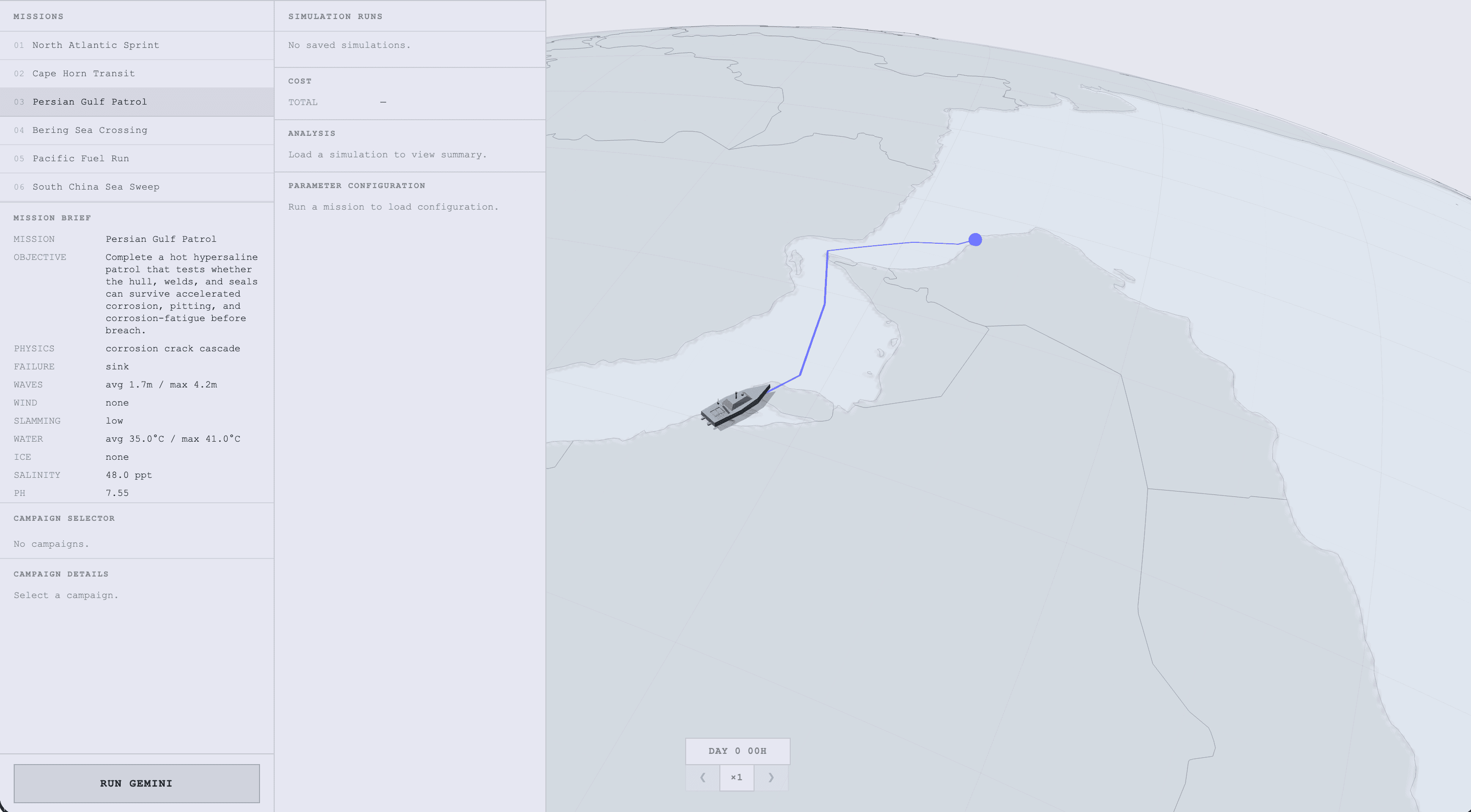
SeaForge lets you change a ship’s design and see where it fails over a voyage. I built the Rust simulation engine, the Gemini-guided design evaluation loop, and the Express backend that connects the engine to the team’s web app.
- Rust
- Gemini
- Express
- React
What happens to the ship during a run
The engine advances the voyage in time steps and tracks nine hull zones, fuel use, and stability. Corrosion reduces plate thickness, wave loading accumulates fatigue, and cracks grow until a failure threshold is reached. Each run produces snapshots and a diagnosis of what failed.
I implemented the engineering models in Rust, including hull-girder stress and stability calculations. That makes it possible to compare changes in material, thickness, weld quality, and other design parameters against the same voyage.
Testing Gemini’s next design
I give Gemini the configuration and failure diagnosis, then run its proposed changes through the same engine. The runner saves parameters, results, and assessments for each iteration, so we can inspect whether a revision actually helped. The simulation does the evaluation; Gemini proposes the next design.
My Express API passes JSON to the compiled Rust binary, reads the structured output, and handles timeouts and temporary-file cleanup. I also contributed to the application layer, while teammates built other parts of the interface and visualization.
- Vessel configuration
- Rust voyage model
- Failure diagnosis
- Gemini revision
Implementation references
The hackathon result
Our team won $5,000 for Best Use of Gemini at the 2026 AI Engineer World’s Fair Hackathon. SeaForge is a working exploratory simulator with simplified physical models; it has not been validated for real-world vessel design.